
I Lost $2,847 in Affiliate Revenue (Here's How I Fixed It)
This is a guest post from Linkfuse user GadgetBeats sharing their experience with international affiliate revenue optimization.
Last October, I was reviewing my Amazon Associates dashboard when something didn't add up. My tech review blog was pulling in 50,000 monthly visitors and generating around $9,600 in affiliate commissions. Good numbers. But they should have been much better.
I've been running GadgetBeats for three years now. Reviews of laptops, monitors, mechanical keyboards, audio gear—the usual tech enthusiast fare. The site grew steadily, the content ranked well, and the affiliate income became a genuine part of my livelihood.
But that October morning, staring at a Google Analytics report next to my Amazon dashboard, I finally noticed what had been hiding in plain sight for months.
The Numbers That Didn't Make Sense
Here's what I was looking at:
Google Analytics showed:
- 50,000 monthly visitors
- 60% from the United States
- 40% international (UK, Germany, Canada, Australia, India, and dozens of other countries)
Amazon Associates showed:
- Roughly $9,600 in monthly commissions
- The vast majority from amazon.com
I pulled up a more detailed breakdown and the picture got worse. My US traffic was converting at about 4%—solid for affiliate content. But international visitors? Their conversion rate was barely 0.8%.
Forty percent of my traffic was essentially dead weight.
I sat back and thought about this. These weren't random visitors. They were reading the same detailed reviews, spending the same time on pages, clicking the same links. So why weren't they buying?
The "Aha" Moment
The answer hit me when I clicked one of my own affiliate links using a VPN set to Germany.
The link took me to amazon.com. Not amazon.de. amazon.com.
And there I was, a hypothetical German shopper, staring at a product page showing prices in US dollars, offering shipping that either wouldn't deliver to Germany or would cost more than the product itself.
No wonder they weren't converting.
I tested it from the UK. Same thing—sent to the US site. Canada. Australia. Every single international visitor was landing on a storefront that couldn't serve them.
The problem wasn't my content. It wasn't my traffic quality. It was my links.
Breaking Down the Actual Revenue Loss
Once I understood the problem, I wanted to know exactly how much money I was leaving on the table. I pulled together my analytics data and did the math.
What Was Actually Happening
US Traffic (60% of visitors = 30,000 clicks)
- Conversion rate: 4%
- Conversions: 1,200
- Average commission: $8
- Monthly revenue: $9,600
International Traffic (40% of visitors = 20,000 clicks)
- Conversion rate: 0.8%
- Conversions: 160
- Average commission: $3 (lower-value impulse purchases)
- Monthly revenue: $480
Total: $10,080/month
What Should Have Been Happening
Now, international shoppers don't convert quite as well as US visitors—different buying habits, currency considerations, varying Amazon Prime adoption rates. But they don't convert five times worse when they're actually sent to the right storefront.
Industry benchmarks and data from other affiliates suggested a realistic international conversion rate of 2.5-3% when links are properly localized. Let's be conservative and use 2.5%.
International Traffic (Properly Localized)
- Clicks: 20,000
- Expected conversion rate: 2.5%
- Expected conversions: 500
- Average commission: $6 (accounting for currency differences)
- Expected monthly revenue: $3,000
The Gap
| Metric | Actual | Potential | Difference |
|---|---|---|---|
| International conversions | 160 | 500 | +340 |
| International revenue | $480 | $3,000 | +$2,520 |
| Total monthly revenue | $10,080 | $12,600 | +$2,520 |
Over twelve months, that's $30,240 in lost revenue. In the three months since I'd last looked closely at my analytics, I'd lost roughly $7,560.
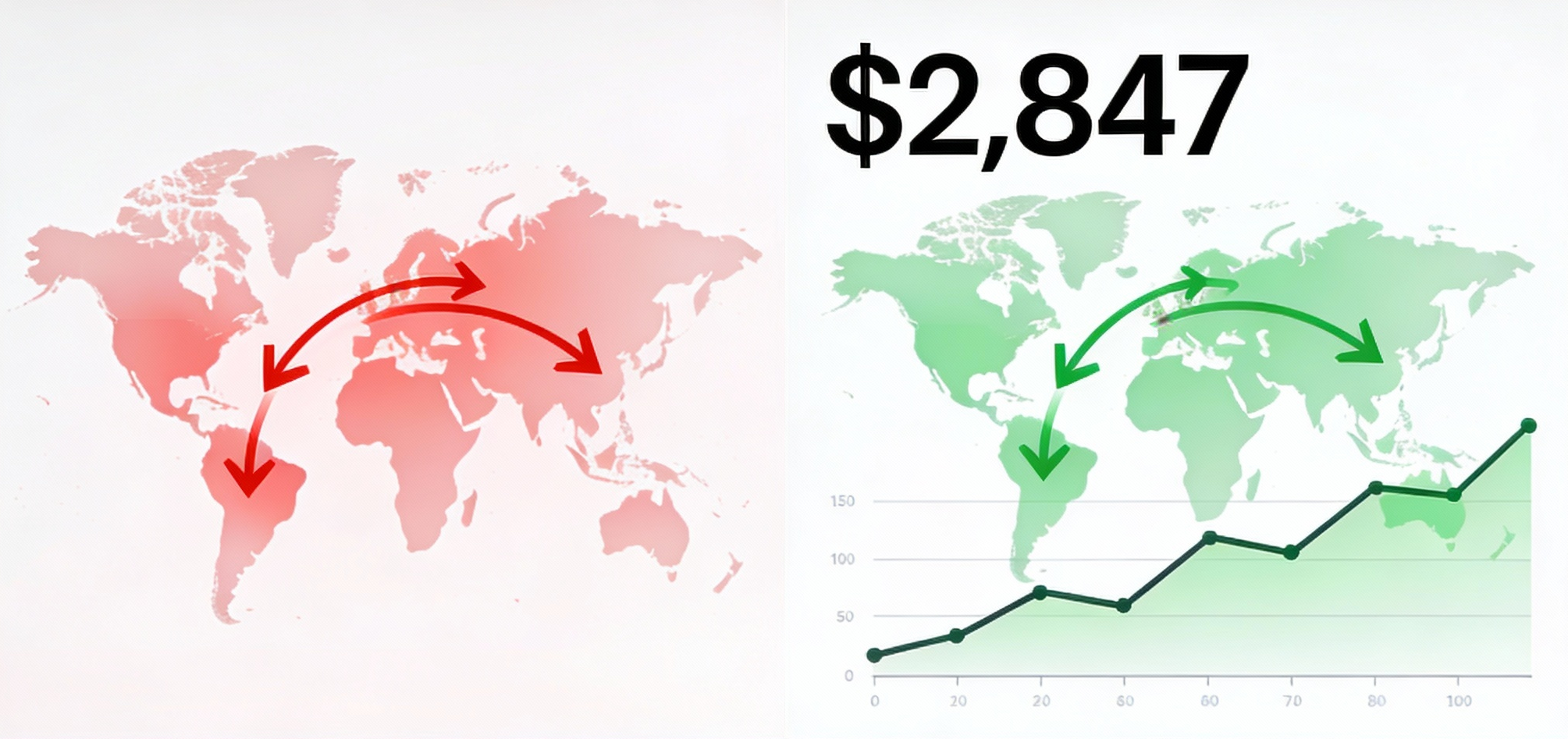
The $2,847 in my title? That's what I calculated I'd lost in the single month of September alone, once I factored in that month's higher traffic from back-to-school content.
Three thousand dollars a month, evaporating into nothing because my links pointed to the wrong Amazon.
Understanding Link Localization
Here's what I learned in my frantic research that followed.
Link localization (also called geo-targeting or geo-routing) automatically detects where a visitor is located and redirects them to the appropriate regional storefront. A reader in Germany gets sent to amazon.de. Someone in the UK goes to amazon.co.uk. Canadians land on amazon.ca.
The mechanics are straightforward:
- Visitor clicks your affiliate link
- Localization service detects their location (via IP)
- Visitor is redirected to the correct regional Amazon
- Your regional affiliate tag is attached so you still earn the commission
The key requirement: you need affiliate accounts with each regional Amazon program. I already had accounts with Amazon US, UK, Germany, and Canada—I'd set them up years ago and mostly forgotten about them.
Amazon's own solution for this is OneLink. It's free, which is nice, but after testing it, I found it inconsistent. It relies on JavaScript (which ad blockers can break) and often sends visitors to search results pages rather than the exact product. Not great for conversions.
Setting Up Linkfuse
After evaluating several options, I went with Linkfuse. Two main reasons: it offered the features I needed, and the pricing model made sense for my situation (free, supported by occasionally using Linkfuse's own affiliate tag on a small percentage of clicks—far cheaper than monthly subscriptions that scale with traffic).
Here's how the setup worked:
Step 1: Connect Your Affiliate Accounts
In Linkfuse's dashboard, I added my Amazon affiliate IDs for each region:
- US:
gadgetbeats-20 - UK:
gadgetbeats-21 - DE:
gadgetbeats-21 - CA:
gadgetbeats-20
Took about two minutes. Just entering the tag IDs—no API connections or complex integrations.
Step 2: Create Localized Links
For each product I recommend, I now create a single Linkfuse link. I paste in the US Amazon URL, and Linkfuse automatically finds the same product on other regional Amazons (or lets me specify alternatives if the exact product isn't available).
The result is one short link—something like lfuse.net/abc123—that works globally.
Step 3: Replace Existing Links
This was the tedious part. I had hundreds of posts with amazon.com links embedded throughout. Linkfuse's WordPress plugin helped here—it can automatically scan your content and convert Amazon links to localized versions. For my older posts, I worked through them gradually over a couple of weeks.
Step 4: Enable Deep Linking (Bonus)
One feature I hadn't expected: mobile deep linking. When someone on a phone clicks my link, Linkfuse can open the Amazon app directly instead of the mobile website. App users convert at significantly higher rates than mobile web visitors. This was an extra optimization I hadn't even known I was missing.
The Results: 30 Days Later
I gave it a full month before pulling the numbers. Here's what I saw:
Before Localization (September)
- Total clicks: 52,000
- US conversions: 1,280
- International conversions: 168
- Total revenue: $10,527
- International contribution: 4.6% of revenue
After Localization (November)
- Total clicks: 49,000 (slightly lower traffic month)
- US conversions: 1,176
- International conversions: 412
- Total revenue: $12,894
- International contribution: 19.2% of revenue
Even with 3,000 fewer clicks, I earned $2,367 more. International conversions jumped from 168 to 412—a 145% increase.
The international conversion rate went from 0.8% to 2.1%. Still below US levels, but dramatically better than before.
The Breakdown by Region
| Region | Clicks | Conversions | Conv. Rate | Revenue |
|---|---|---|---|---|
| US | 29,400 | 1,176 | 4.0% | $9,408 |
| UK | 7,840 | 172 | 2.2% | $1,204 |
| Germany | 4,900 | 98 | 2.0% | $686 |
| Canada | 3,920 | 94 | 2.4% | $658 |
| Other | 2,940 | 48 | 1.6% | $338 |
The UK alone was now generating over $1,200 monthly—more than double what all international traffic had generated before.
What I Learned
This experience taught me several things that might help other affiliate marketers:
1. Your Analytics Are Telling You Something
The data was there all along. I had the traffic breakdown. I had the conversion rates. I just never connected the dots. If you have significant international traffic and low international conversions, investigate why before assuming those visitors just don't buy.
2. Amazon OneLink Isn't Enough
I'd actually had OneLink enabled for over a year. It wasn't working reliably. The JavaScript-based approach meant ad blockers interfered, and the product matching was inconsistent. A dedicated link management tool solved problems OneLink couldn't.
3. Regional Affiliate Accounts Are Worth the Setup
Yes, it's annoying to apply to Amazon UK, Amazon DE, Amazon CA separately. Yes, you have to meet their individual thresholds. But once you have those accounts, your international traffic becomes genuinely monetizable. If you haven't set up regional accounts, do it now—future you will thank you.
4. Mobile Deep Linking Matters More Than I Thought
A surprising amount of my traffic came from mobile devices. Before, those visitors landed on Amazon's mobile website and often bounced. Now, with deep linking opening the Amazon app directly, mobile conversions improved noticeably. It's a small detail that compounds over time.
5. Old Content Is Leaving Money Behind
My archives had hundreds of posts with non-localized links. Every piece of evergreen content was underperforming internationally. Updating old posts is tedious, but the ROI is immediate—as soon as I updated a popular post, its international revenue improved.
The Bigger Picture
Here's the thing: I'm not a huge publisher. Fifty thousand monthly visitors is respectable but not massive. If I was losing nearly $3,000 monthly to broken international links, larger sites are losing proportionally more.
I've talked to other affiliate marketers since this experience, and the pattern is remarkably consistent. Most of us set up our sites focused on US visitors, never properly configured international monetization, and left money on the table for years.
The fix isn't complicated. The tools exist. The setup is straightforward. You just have to actually do it.
If you're running affiliate content and have any international traffic at all—and in 2026, almost everyone does—check your conversion rates by country. If international is dramatically underperforming domestic, you probably have the same problem I did.
And unlike most problems in this business, it's one you can solve in an afternoon.
Have questions about link localization or want to share your own experience? Drop a comment below or find me on Twitter @gadgetbeats.